I meditate on the beauty You have brought into my life,
I recall a favorite childhood haunt, a creekbed–
boughs lilting overhead, bobbing leaves and dappled light.
The splash, the instant chill of my feet in the water.
When I was young, I went there to play.
But as I grew, I went there to meet with You.
I always knew You were there
in the muddy pools and rocks
Of the everyday and the places we play.
The places we go to get away.
You met me among toads and lizards and decaying leaves
that offer up a holy incense of life-from-death.
You were always Full Circle.
Wholeness.
You were always present in all things,
In the decomposition of the old
and the sprout of the new rising out of it–all of it beautiful.
The blossom inseparable from the breakdown
of fallen things time-transformed into rich earth.
The wild sweet william that brightened those woods
no less splendid than pale roots entangled
with pillbugs and moss.
I find belonging among your creatures
(even though I cannot now run to those woods).
I take my place in your dynamism,
for a rare moment, thankful to be myself–
that self who got to be alive in Your world for just a moment
and see You in rough bark and white-tailed deer.
(They huffed when they saw me, and bounded lithely over the hill.)
What can I think of heaven–
and what can I say about Eternal Life?
O Lord, my eyes are not lifed up;
My eyes are not raised too high;
I do not occupy myself with things
too great and too marvelous for me.

But I have calmed and quieted my soul,
like a weaned child with its mother;
like a weaned child is my soul within me.
(Psalm 131:1-2 ESV)
Impulse of Life, never dormant, always making and remaking,
Resurrecting and laying to rest,
I am borne by Your profuse energy
and nurtured by the constancy of Your motions.
“Blessed is the one . . . whose delight is in the law of the Lord, and who meditates on his law day and night. That person is like a tree planted by streams of water, which yields its fruit in season and whose leaf does not wither– whatever they do prospers. (Psalm 1:1a, 2-3 NIV)
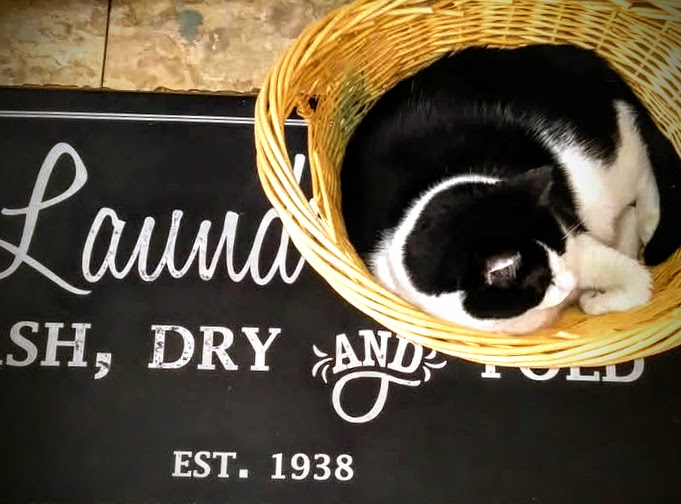
Our Cat, Creme Pie, in his daily demonstration of rest – Edited in Lumia Selfie
Lord, I rest in You.
I accept myself as a gift from You.
I acknowledge that Ican love myself while I work on myself.
I realize improvement is not about becoming someone else, but about growing into my best self.
Thank You for reminding me to rest.
Rest means more than just doing nothing, for our bodies do a lot of vital work while we are asleep, and can’t live without it!
Rest can also mean that something abides within or is built upon another thing. To say of someone, “Their strength lies in their humility does not mean their strength simply lies there doing nothing; it is nourished by and becomes the active outflow of its source.
So, I abide in You, my Love, I sink my roots deep to draw from You, the source of my being, my breath, my uniqueness, and my passions.
I will do through You
as I rest in You.
“The Lord replied,
‘My Presence will go with you,
and I will give you rest.'"       – Exodus 33:14
 I pray that, according to the riches of his glory,
he may grant that you may be strengthened in your inner being
with power through his Spirit
and that Christ may dwell in your hearts through faith,
as you are being rooted and grounded in love.       – Ephesians 3:16-17
This song came to me unexpectedly through a Spotify suggestion last year. At that time, I felt burdened with urgency to figure everything out. To find all the answers and embed myself in just the right religious community and set of rituals, so I could feel like I belonged again.
Immediately, I was reminded I am not alone, as John Lucas’ almost whispered lyrics and the pulse-like staccato of his guitar brought me into his meditations on faith and uncertainty. (Isn’t it wonderful how music can make us feel connected? Even in times of hurt, when nothing else is getting through?)
Thanks for reading! Subscribe for free to receive new posts and support my work.
“Where All New Life Begins” gently underscores the things many of us are learning on our deconstruction journeys. That faith isn’t about having all the answers. That peace may come in empty spaces and beauty in the embrace of mystery.
I hope you will be nourished by this pensive acoustic number, as I was.
[Ahh, sniffle sniffle! A stubborn illness, paired with mandatory overtime at my job, interfered with my writing goals last week. Upward and onward, eh?]
Losing My Religion
The concept of spiritual deconstruction seems to be all over my YouTube feed, in the list of podcasts I browse, and the bookshelves I peruse. It’s quite a contrast to how I felt around 2012, when I became engulfed in what I considered to be a “spiritual battle,” as a young mom, a lay minister, and a Bible college student. When I began wrestling with my spiritual beliefs, I knew no such terms as exvangelical or recovering fundamentalist, no movement called “Empty the Pews,” or “The Rise of the Nones.”
I just thought I was damned. I felt like the lyrics in an R.E.M. song:
“That’s me in the corner/that’s me in the spotlight, losing my religion.”
. . . however small my corner and my spotlight may have been.
I felt alone. The Christians I talked to thought I was an idiot—and a blasphemous one, at that—for struggling in my faith. The non-Christians I encountered thought I was an idiot for being a Christian in the first place.
A Dark Night of the Soul
I couldn’t not believe in God, for my experiences with God had been too real. God had whispered love to me through the treetops, met me in the lonely places and the sleepless night, thrummed through my soul, opened my eyes to joys that made me weep and beauty that made me weak in the knees. God . . . directed me to friends and books, poems and scriptures just when I needed them. God alighted on my shoulder like a bird and sung to me, sung through me. I know this sounds like nonsense. I don’t know how to explain these sublime experiences in humdrum words.
But my experiences with a fractured church that chose its own emphases—often different from what Christ taught—and devoured its members, especially those who cared the most and worked the hardest—those were very real, very visceral, too.
My questions went deeper than church, though. “Let God be true, and every man a liar” (Romans 3:4), I thought. It was my favorite comeback to the common excuse, “I can’t believe in God, because some people are hypocrites.” But that argument couldn’t help me with a theological framework that made no sense. I didn’t struggle to believe in God or even in miracles, but I did struggle to believe that the God presented by the Bible and my fundamentalist-evangelical church, was good. I didn’t fear there was no heaven or hell. Rather, I feared being consigned to a very real hell, because I felt that I could not obey “the first and greatest commandment” which is to “love the Lord your God with all your heart, soul, mind, and strength” (Matt 22:37-38).
Respect, I could do. Memorizing scripture verses, showing up to every church function, and speaking the evangelical lingo were all things I had been doing well since I was in my cradle. But how could I, with any integrity, love or even feign love, for the Old Testament God who had ordered the slaying of Canaanite men, women, and children—even infants, even pets? Or the God who had turned Lot’s wife into a pillar of salt for glancing behind at the violent destruction of her homeland and her relatives (Genesis 19:26), but venerates Lot as a “righteous man” (2 Peter 2:7-8) . . . for what? For his rampant drunkenness and incest with his daughters (Genesis 19:30-38)?
Feigning love for that God made me feel like a worm, like a victim who keeps crawling back to her abuser, to build up his ego and gaslight herself for having a problem with his cruelty.
Anyway, so much of this Bible nonsense had nothing to do with the God I knew through my own spiritual experiences. It made me feel I had been deceived, either by the God I knew and thought I loved, or by the Bible writers and the Bible-idolizing Church I had entrusted with my faith.
I wanted to love God, but how could I love—or believe I was loved—by a God who had seemed to sanction the world’s very tilt against women? There is plenty in the Bible to suggest that treating women like sub-human commodities to be traded doesn’t ruffle God’s feathers at all, though he does bother to comment on ‘important’ issues like how the tassels on a men’s prayer cloths should look. How could I love a God whose words through Paul and Peter about female submission and male headship have been used to excuse domestic abuse and oppressive discrimination. Domestic abuse like that which terrorized my childhood and left me recoiling from masculinity—and recoiling from myself, horrified at my own femaleness, at the same time?
Why couldn’t Christians have real conversations about concerns like these, I wondered, without someone—usually me—getting accused of having a “deeeeeeemon”?
Furthermore, how could I love the medieval Catholic God selling indulgences when it wasn’t in bed with corrupt kings. How could I honor the God of the invading rapists and slave drivers, Columbus and Cortez? How could I identify with the ‘Christian’ founding father, Thomas Jefferson, keeping slaves while he wrote “all men are created equal.” Taking sexual advantage of Sally Hemmings, a slave, with no legal rights, while his humiliated wife wept over the corpse of her own child upstairs? How could I identify myself with complacent ‘Christian’ America whites starving indigenous people on reservations? With missionaries stealing indigenous children to abuse them in boarding schools? How tout, “Jesus Saves and Transforms!” after so many ‘good’ ‘Christian’ white folks refused to share a drinking fountain with black people? How and why should we identify with everyday ‘Christian’ German folks who could suddenly be convinced to take part in the horrors of Kristallnacht, because some loud-mouthed politician had convinced them that punishing a scapegoat ethnic group would Make Germany Great Again?
(See, what is paltry, I can easily describe in paltry words.)
Why couldn’t the Church have a meaningful dialogue about issues like these, without doubling down and making excuses. Why couldn’t they follow their own formula for “salvation” and, instead of growling, “Radical Leftist!” at anyone hoping to see better than dog-eat-dog from the Church, expressing some humility? Some repentance? Isn’t that what Christians are supposed to do? Instead of refusing to search their own hearts and their own history and blaming the victim for the uncomfortable shame of the victimizer?
I could get my mind around an imperious and all-powerful God who could very well wreak all kind of injustice any time he wanted to. Sure. But could I get my heart around that? That is, could I love it with all my heart, soul, mind, and strength?
Not a chance.
Enter Deconstruction
I tried ‘getting saved’ again. I tried getting baptized a third time. I read books. I sought counsel.
Then I tried major depression. It was a whole thing.
I came to the conclusion I could not avoid having a relationship with God, as I believed in God, and believed God was everywhere. I did not mind this much, for I also felt a winsome tugging on my heart, as if from the Holy spirit, even as my heart was curdling into hatred . . .
But neither the unavoidability nor the winsomeness was true of the church. I entered into a “wilderness period.” I had to spend some time away from the expectations, the traditions, and the loud voices raised in discord—to discover . . . the countenance of God. So did Moses. So did the ancient Israelites. So did Elijah. So did Jesus. So did Paul. Forty days and Forty nights in the wilderness. Forty years in the desert. Three years in Arabia. It was good for them; I’m not above it.
I determined that since I was going to have a relationship with God, it was going to have to be an honest one. Not one in which I simply said, “Oh well,” about all the harmful and nonsensical aspects of institutionalized Christianity. I had already played the part of the submissive Christian, where I said, “No, I don’t like this, and no, it doesn’t make any sense—and it actually seems to be producing evil, but never mind. I’m going to keep reinforcing this stuff, because this is my religion. Now, let me get back to ironing my husband’s shirts.”
And I think that was a good prayer, for the time. But we are not meant to stagnate. There camea time to move forward to a new prayer:
“God, if I am to know and to love you, I must really know you. In spirit and in truth. And if I am to follow you, if I am to be some sort of ambassador for you, then I must know that what I am representing is not false and will not cause harm others created in your image. I can set this contingency, because I believe that you are good and true, and that whatever is false, whatever is cruel, is not of you. If you are only false and cruel, you are not worth my time. But I have seen you and known your goodness, and I purpose myself to learn about experience you more and not let the hearsay of others get in my way.
The Deconstructionist Wave
If any of this resonates with you, because you have felt the tectonic plates of belief and culture shifting under your feet, you certainly aren’t alone.
In 2024, the Barna Group found that 42% of American adults had “deconstructed the faith of their youth (Barna Group 2024”). And this followed reports that for the last 20 years had indicated a major decline in American Christianity. In 2015, Pew Research Center found the percentage of Americans identifying as Christians decreased eight percentage points between 2007 and 2014. Accounting for general population growth and the time and margins of error, PEW estimated this drop in Christian affiliation of between 2.8 and 7.8 million (Pew Research 2015). During the same period, the number of Americans unaffiliated with any religion (the ‘Nones’) grew from 19 million to 56 million, making the unaffiliated the fastest growing religious group in America (PRRI 2016). More recently, Christianity Today and CNN found that “the rate of self-identified Democrats giving up on church in their 20s-50s doubled from the end of Barack Obama’s presidency to the end of Trump’s” first term, indicating that American Christianity’s tendency to hold conservative political values as a litmus test for faith has spurred many to deconstruct the faith of their youth (Christianity Today 2023, CNN 2024).
Does this mean that deconstruction and/or progressive ideologies are gutting the church?
Well, don’t panic. While faith deconstruction does sound a lot like faith destruction, Barna’s research found only one percentage point of difference between spiritually deconstructed Christians who continue in the faith, and those who do not. Their report simplifies it like this: “more than one-third of committed, church-going Christians relate to the idea of having deconstructed their faith” (Barna Group 2024).
A more relevant question might actually be, “How can this overhaul refocus and revitalize the Church? The church isn’t dying. It’s being reformed. Remade in places you’d least expect. People are celebrating the Way of Jesus on barstools in pubs and in online communities and recovery groups and in Superbowl Commercials and on Instagram posts made by angry-looking women with nose-rings who know the Bible better than the average charismatic preacher who’s about to be caught soliciting sexual favors next week . . .
We’re going to be ok. As I have heard Nadia Bolz-Weber say, ‘the Church’ may lose some real estate holdings, some official numbers and official influence, some universities and media outlets. But people are still going to be gathering around tables, breaking bread, embracing our shared humanity, and recounting the stories of Jesus. And that’s what we’re really about, after all.
Defining Deconstruction
So, what do you think of this deconstruction we’ve been hearing so much about? Is it a fad? A bandwagon? A buzz-phrase? Is it the product of “liberal indoctrination” in universities? Is it the fulfillment of 2 Timothy 3:1-5 and Matthew 24:10-25, which predict mass apostasy “in the last days”? I’ve heard all of these, and I will deal with them in more depth in later posts. But let’s begin by simply defining it and explaining what it means in practice. (Please allow me a minute to sound pedantic—there’s no other way to describe this concept!)
Deconstruction did not begin as a religious concept, but as a method for analyzing meaning in Western society. It was introduced by the postmodernist philosopher Jacques Derrida in the late 1960s. Originally focused on unpacking meaning within the construct of language, deconstructionism calls into question the constructs that societies treat as ultimate reality that are really just figments of our cultural imaginations.
Think of a society that accepts one sex or race as inferior to another, without any serious thought or scientific evidence to back this up.
Think of assuming the best way to get rain to your thirsty crops is to sacrifice a dead animal to a statue of a bull.
These were/are normal attitudes within certain social constructs. But I don’t think we would agree that they represent timeless, incontrovertible truths we are obligated to abide by today!
Similarly, think of a culture defining success as militarism, conquest, or wealth. Imagine this concept is presented as fact or reality—simply the way things are, world without end. But clearly, other ways of defining success do exist. For example, one could measure a civilization’s success by the beautiful artworks it produces. One could measure societal success by the overall health and longevity of its members. Or by its scientific discoveries.
Deconstruction would allow members of that society to get at the roots of their narrow definition of success—to reveal the flustered man behind the curtains pulling the levers. And once they have realized their ‘ultimate reality’ to be as tenuous as a spider’s web, they will be freed to consider new value systems that might better serve their people, and their neighbors.
A Means, Not an End
You can probably see how this philosophical approach lends itself very well to the consideration of religion and its influence on societies. Deconstructionism asks us to consider the origins and meanings of tribal assumptions and social habits we’ve been taught to take for granted. As Christians, we might even think of faith deconstruction as being “transformed by the renewing [our] minds” (Romans 12:2b). Yeah, we get stuck in a rut sometimes. We may get in the habit of overemphasizing this, neglecting that . . . we need to stop and reevaluate our faith once in a while. We need to renew our minds.
Deconstruction is not the end-all. Like any philosophical tool, it can be misapplied or overused. But it also has useful applications that deepen our understanding of ourselves and why we believe and live as we do. It can help us to jettison what was harmful in the past and to move forward.
Is Deconstruction Dangerous?
Deconstructionism comes across as a threat to those who find comfort in tradition and benefit from the status quo. But can we really argue that deconstruction is an adversary of truth?The pursuit of truth must welcome curiosity, and any truth worth devoting our lives to, should be able withstand scrutiny.
Socrates said, “The unexamined life is not worth living.” How do you feel about giving your life to an unexamined faith?
Take courage!
If you believe that God loves you and “no one can pluck [you] from [his] hand” (John 10:28), and if you believe “God is over all and through all and in all” (Ephesians 4:6)—also that “Christ is all and in all (Colossians 3:11)—then shouldn’t you also have confidence that as you explore your spirituality, you do so with the comfort of Divine presence within and all around you?
You get to strip off the dusty old husks–the packaging of religion, about which the Church is content to sing and preach–and get to the real, nourishing kernels within. Sure, now it may be harder to find a congregation in which you don’t feel like an oddball . . . But can we agree that’s a small price for realizing you are the temple?
You will be the administrator of your faith, you the interpreter of Divine communications—in whatever form God chooses to send them. As the prophet Jeremiah wrote: “I will put my law within them, and I will write it on their hearts. And I will be their God, and they shall be my people” (Jeremiah 31:33b NIV).
Are You Wrestling With Aspects of Your Fundamentalist/Evangelical Christian Tradition?
Are you a church worker who feels like you’re on an endless merry-go-round of purposeless church activity? Does it seem that all this activity fails to yield the positive transformation it promises you or the world?
Have you wondered why the Church seems to eat its own, devouring leaders and faithful laypeople with endless work and criticism, shame and fear?
Do you feel dishonest trying to convince nonbelievers that your religion has all the answers to set the world right—when you know its people are just as messed up as anyone else and its institutions just as greedy and corrupt?
Are you a devout believer who can’t help wondering why the Church of Jesus, who was a friend to “the least of these,” has stood complicit in genocide, slavery, misogyny, and racism throughout history? Why it often courts the grossly wealthy and blames the poor?
Are you tired of your faith being reduced to a few hot-button political issues, like opposing abortion and the LGBTQ+ community, which Jesus never spoke against? In fact, do you wonder why Christ-ians are more concerned with what Paul and Moses taught than with what Christtaught?
Let’s go deeper.
Maybe your struggle isn’t just with church but with the whole framework of your beliefs, and you wonder . . .
Why you’re supposed to forgive, but God gets to hold a grudge for eternity—against everyone—over a piece of fruit?
Why God only forgives those who confess and repent, but you’re supposed to forgive those who harm you and are unrepentant about it?
Why God slaughtered entire Old Testament villages and then told you to be gentle, long-suffering, and self-controlled?
How we even got the Bible in the first place? Who got to decide what was in it? And why do we have to take their word for it?
Similarly, how did God control the Biblical authors so that no trace of their human bias or ignorance entered our ‘inerrant’ texts?
Did he turn them into zombies?
What about freewill? Many of our churches preach that freewill is so sacred that all humanity has to suffer and die, and potentially be tortured for eternity just so freewill can exist.
So . . . God won’t suspend freewill to prevent a six-year-old girl from being sex trafficked, but God will suspend it so that, for instance, Samuel can write infallibly about the exploits of David’s “mighty men”?
Did God similarly suspend the free will of all Bible interpreters and translators over millennia . . . so that no trace of their human fallibility entered the sacred text, either?
Why we’re letting our understanding of history and science be dictated by ancient men with far less information than we have now.?
Have you ever thought maybe the supernatural events and historical factuality of Scripture emphasized in your church isn’t the point . . .
and that when we emphasize those, we are missing some wonderful spiritual truths and moral teachings that could really help our world?
Asking Questions is Scary Business
When you’ve been indoctrinated to believe any deviation from church consensus is punishable by eternal hell, it can be incredibly scary to begin asking questions. On the other hand, you may sense, as I did, that our intellect and integrity will die if we don’t reckon with these issues.
I am Elizabeth, a deconstructing Christian dedicated to keeping the faith. I write because I’ve wrestled with questions like the ones above. I know there’s a lot on the line there.
If you wrestle through those questions with an open mind, do you end up losing heaven? Do you lose your morals?
Do you lose identity? How about hope? Does that go, too?
What about connection? It’s likely if you were all-in on the faith, veering from the herd may means you risk losing your entire community.
And what about purpose? You’ve been raised to believe you have a great purpose in the cosmic battle between Good and Evil. What’s your place in the universe now?
I’ve been there. I am there. I write to come alongside you on your path.
A Guide? How About a Companion?
I call this blog “A Deconstructionist Guide to Keeping the Faith” only because it’s catchy. I don’t consider myself to have reached some plane from which I’m entitled to “guide” anybody. Unlike my former Evangelical self, I won’t claim authority or promise certainty. But I give only what is mine to give, and that is my witness.
So, moving forward, I will be posting once a week, typically on Saturday mornings, to share my journey with you. We will be exploring . . .
Some of the questions listed above, and more.
Perspectives on scripture and doctrine that you may not have considered before.
Authors, musicians, and content creators who can help us along the journey.
Discussion on what’s next. How do we build meaningful spirituality post-deconstruction?
Current events and how to respond to them in light of Jesus’ teachings.
Observations, epiphanies, meditations, and prayers
And finally, a healthy dose of the Lyrical as we deal with the Real.
Let us reclaim some of the wonder we have lost to disillusionment. Faith has branches in the gritty ‘real world,’ but it is rooted in profound mystery.
When Loving God Meant Leaving the Church
I used to preach and teach in the grand old tradition of quasi-fundamentalist Evangelicalism. For years, I led worship, sang, and played keyboards. I hosted prayer meetings, taught Sunday School, and led youth. I believed I was called. I pursued ministry education and fulfilled the requirements for credentialing in my denomination, the Assemblies of God.
But the deeper I embedded myself in faith, study, and ministry, the more glaring appeared the holes in our theological system. The more obvious the inconsistencies in our doctrines and the discrepancies between our stated beliefs and lived priorities. As I kept working in the church, I grew increasingly disillusioned with the fact that we just seemed to be amusing ourselves with insular church activities. I grieved our stubborn insistence on what I considered religious nonessentials:
Think . . .
Styles of worship
Debates about creation/evolution, miracles, and the rapture
Biblical literalism/inerrancy
Purity culture and gender roles
Doctrinal statements, and
Political loyalty tests.
I argued that our Christian community’s misplaced priorities ensured that we could not connect with spiritually hungry people in a modern, democratized world. It seemed that for every silly churchism we made essential, we were obscuring the real, hope-giving, and life-changing stuff of the Gospel.
At last, I could not reconcile common church attitudes and practices with the Christ around whom, supposedly, our faith revolved. What? Shame the victim and coddle the abuser? Give the best seat to wealthy church members, then overwork and criticize the poor ones? If the Church, with all its grand claims, could do no better than the rest of the dog-eat-dog world, what was the point in adhering to it?
A free ticket to heaven? A social club? Was that what this was really all about?
Why I Am Keeping the Faith
But I am here because I believe there is a point to keeping the teachings of Jesus, and I believe the core of those teachings is as beautiful and life-giving as ever. I just had to peel back the layers of Churchism to get at that beauty.
Like many, as I deconstructed my faith, I found my problem was not with God or with spirituality, but simply that my faith was outgrowing the container I used for these things. The container of fundamentalist Evangelicalism was beginning to limit and confine my connection with God, though it had once facilitated it.
As a good friend of mine says, “Even the term Christian has become too fraught.” It brings up connotations of prudes and bigots, televangelist grifters, and comfortable, white retirees crying “Persecution! Reverse-Racism!” every time a white Christian doesn’t receive favoritism. Cringe.
I prefer the term Jesus-follower, for it denotes a measurable goal to follow the teacher of great tenets like:
“You shall love your neighbor as yourself” (Mark 12:31 NRSV).
“So in everything, do to others what you would have them do to you, for this sums up the Law and the Prophets” (Matt 7:12 NIV).
“You know that the rulers of the Gentiles lord it over them, and their great ones are tyrants over them. It will not be so among you, but whoever wishes to be great among you must be your servant . . . just as the Son of Man came not to be served but to serve and to give his life a ransom for many” (Matt 20:25a-26, 28 NRSV).
“‘Truly I tell you, whatever you did for one of the least of these brothers and sisters of mine, you did for me.’ . . . Truly I tell you, just as you did not do it to one of the least of these, you did not do it to me’” (Matt 25:40b, 45b NIV)
Jesus modeled inclusion of the outcast and downtrodden. He offered tangible care for the poor and sick, because he saw the value in everyone. He didn’t settle for the mundane pursuit of comfort, wealth, and power; he pointed us to something higher.
Spiritual Deconstruction Does Not Equal Spiritual Destruction
If you are wrestling with questions you can neither shake nor answer according to your religious framework, the discomfort might just be growing pains. I have heard a bit of outcry from the Fundy-Evangelical segment complaining that deconstruction is demonically inspired to destroy the church in the last days. They equate spiritual deconstruction with a full departure from faith in God. Of course, it is true that for many, faith deconstruction has been an off-ramp from theism.
But allow me to posit another way to think of faith deconstruction.
Maybe it’s about maturing. And spiritual maturing is a choice. The path is there, but no one’s going to make you take it. Are you ready to shed the manmade baggage and take a conscientious look to determine what about your faith is “true . . . noble . . .right . . . pure . . . [and] lovely” (Phillipians 4:8 NIV)?
If you are worried your struggles mean you are losing a cherished relationship with God. I remind you that your commitment to spiritual integrity does not signal that there is nothing where your faith used to be! Instead, it indicates that a lot of chaff is about to get blown away!
Stuff just got Real.
I want to close by telling you the one thing I most needed to hear when I feared my faith was unraveling:
Deconstruction does not have to mean destruction.
Spiritual deconstruction can mean honing, rather than disowning, your faith!
Moving away from organized Christianity has meant that I now interact in faith, rather than in certainty, with a God whose shape I no longer try to define or control. I find God more mysterious, sure, but also more loving, creative, and expansive than I did before. I found that it’s more important to trust in the goodness and constancy of God than in the infallibility of human institutions. If one of these is eroding my trust in God, I’ll leave the institution and keep God.
I also have a greater focus on what we can and should do to better the lives of our fellow humans. And I have a greater sense of purpose to interact humbly and justly with this earth and all its creatures.
So, I finish with encouragement that faith deconstruction need not be a dead end where you drop off who you used to be.
It is also an open door to who you are becoming.
Welcome, dear Community! I look forward to growing with you!
Next week: Why I Kissed Churching Goodbye, Pt.2—A deep dive into what faith deconstruction means and how it’s reshaping the Church for the better.
God. Sweet Spirit. I am here with You. Just You. And just me.
Help me to build my identity in these spaces when I am with You, and I know you regard me just as I am. No judgment from people who don’t know the whole story. No contempt and sneering born more out of someone else’s insecurity than out of my failings. No bad advice from ‘the friends of Job,’ given more to make the giver feel important than to help the recipient gain clarity. No comments from uninvested onlookers.
Let self-concept form in these moments when I understand that Your love doesn’t most often look like saccharine antics of affection or sweeping acts of vindication. When I understand that Your love most often looks like . . . a steady gaze.
A gaze that never turns away but looks and keeps on looking. A gaze that never shows surprise or contempt and never seems confused or incredulous. A gaze that never looks right past me or right through me. A gaze that never finds me too small to be seen. A gaze before which I am never hidden by the crowd, nor by the circumstances, nor by the emotional baggage of the onlooker.
Your silent gaze confers dignity. Or does it simply concur with the innate dignity that is a birthright?
(Dignity, a birthright, however contested by mobs of imps–usurpers, who have no jurisdiction to contest dignity or worth, but who parade around practicing law without a license. They con the crowds–we con ourselves–to believe these judgments are valid.)
Before Your clear-eyed gaze . . . I am.
I am never too perplexing to be understood. I am never too infuriating to be countenanced; I am never too embarrassing to be looked in the eye. I am not too far gone, but I am not particularly impressive, either. Nevertheless, I am never such an inconvenience that this Divine parental eye cannot find the time to meet me. When I am with the I Am, I just . . . am.
My New Year’s prayer? Let me grow in the consciousness of this gaze. Let me live more and more in the steadiness of Divine love. I pray, sweet Spirit, that as I contemplate your comprehensive countenance, I will accept your acceptance and stop fighting to be seen and understood. I pray that I will drop my defenses and that, being unafraid, I will look around me to truly see and accept those all around me, who also bear Your image and the light of Your clear-eyed gaze.
I wonder what happens when you ask God to speak. How does he answer? I’m always curious about other people’s experiences of God. It is not so much that I am concerned with learning the ‘right’ way to have these experiences. Rather, I think there are attributes of God we can learn only through knowing one another and sharing our spiritual experiences.
For me, spiritual experience often comes as an impression so strong, I’ve just got to write it down. Because that’s what I do. I write. And what God does? Well, I think he meets us where we are.
So, one recent morning, I sat on my porch in the first gray light with a notebook open on my lap. Waiting. Lonesome for a dialogue with the Spirit that has become so familiar, so sustaining to me. I closed my eyes, and that lonesomeness was itself like a prayer, a psalm, a plea.
I wrote down the impressions that followed. Did God speak? Did He not? Call it wishful thinking? Call it . . . faith?
I am with you always.
“Ok. Is that it, Lord?” I asked, hoping for more, though really, “I am with you always” is a pretty big deal and worthy of contemplation.
Divine Life goes on and on, continued my impression of the Spirit. Far beyond all of this packaging you see all around you. Still, you must do what brings you joy. It is all you have. You cannot embrace the whole of Divine Life. Only your spark of it.
It is yours to do as you do, to do it to the best of your ability, and to take joy in the authenticity of it. As the cardinal joys in his single, bright chirp—for that is his chirp. His song to sing. His person to be.
And do not be afraid tobe! Plenty of legitimate concerns occupy the cardinal; cardinals face predators, competition for resources, the vagaries of weather . . . But the cardinal is not afraid of being a cardinal. The cardinal is not afraid it is not being cardinally enough. It is not afraid of being too cardinally. The cardinal is not afraid there is no place for its song among all the other sounds of nature. It is not afraid its song sounds too loud or too abrupt among all the other noises.
The cardinal is not concerned with telling the other birds what their songs should sound like or what kind of birds they should be. It is not concerned with grouping all the cardinals together and separating them from the rest of the birds.
It is not afraid of tomorrow.
Be in that way, my dear.
(Are you comfortable being?)
Just then, in the growing morning light, a female cardinal alighted on my garden arch, chirped brightly and flew away.
The summer I was 10, my mom worked as the secretary at our church, and I often accompanied her there. One day, encircled by paper-dolls and paperback books in my hiding spot under the stairs, I was seized by a new curiosity: What was it like to touch the black-lacquered baby grand piano in the sanctuary? Hmmm.
I knew kids were not allowed in the sanctuary unattended, and they most certainly were not allowed to touch the musical instruments! But, like any good fundamentalist kid, I was well-versed in scripture even by that age. And despite my homemade pink dresses and general sweetness, I was also . . . well, argumentative! I reasoned that if I got caught stealing a seat at the piano, I could defend my infraction by comparing it to David entering “the House of God” and eating “the consecrated bread”1 in 1 Samuel 21. which “was not lawful for him”2 to do . . . but which Jesus seems to defend in Matthew 12. Yeah. Who could argue with that? I thought, and made for the back stairs leading to the sanctuary.
Oh, who was I kidding? Foolproof metaphorical defense of not, I was trembling as I pressed through the sanctuary doors and tiptoed over the squeaky floorboard between the altars. I chuckled at myself for doing so. You’re here to make noise, aren’t you? To avoid drawing attention, I had not even dared to put any lights on and approached the piano only in shadows highlighted by the glow of green, pink and gold light from the stained glass windows.
When I sat down at the piano, however, I lost my fear of the pastor to the thrill of heavy keys sinking under my fingers. The hymnal was open to “What a Day That Will Be.” A childhood favorite of mine, because it contained imagery, rather than just abstractions. My hands gently roved the keys searching for a melody I already knew by heart. I may have been little and clumsy, with grubby, pudgy hands . . . Hands and bodies come in a variety of shapes and sizes, but maybe spirits are all the same size, and a little body encompasses a full-grown soul. So, then those pudgy fingers of mine searched the piano with all the passion of artists to bring the Soul and the Senses into syncopation. Chubby little hands, yeah, but with all the impetus of the Created to reflect the Creator! At last finding that one familiar melody among 88 monochrome keys, I wondered if this was how sculptors felt when they first glimpsed a face in a block of clay.
“What day that will be, when my Jesus I shall see, when I look upon His face, the One who saved me by His Grace . . .”3 I played and sang. The notes resonated high into the vaulted ceiling while multicolor light diffused softly through stained glass into reflecting pools on the piano top. “When He takes me by the hand and leads me through the Promised Land, what a day, glorious day–” My hands shook. I could play no more. The moment was too beautiful. Strangely, I felt tears clinging to the corners of my eyes. Children don’t often cry if they are not scared or sad, hurt or angry. What was this new sensation of being moved to tears by the poignant and the profound? I felt privileged to experience it. (Yes, like any good evangelical kid, I’m still down with three main points, heavy on the alliteration!) I remembered a line my mom used to quote from Chariots of Fire: “When I run, I feel His pleasure.”4That’s what this is like, I thought. I could feel God smiling upon me as I played. A countenance shining amidst the piano notes sifting back down to earth through beams of rose-gold light.
I crept away from the sanctuary that day with a very young sense of being in love. It was what you might call “a God Moment.” I am confident it will not be a parade of clichéd milestones that pleasantly haunts me upon my deathbed. Not graduations, weddings, birthdays, or holidays, but moments like my first at the piano. Not the moments I planned in detail, but the moments God planned to surprise me. I am thankful.
So, my friends, do you have a collection of such memories? I feel sure you do. I urge you to take them out, dust them off and treasure them by sharing, rather than by storing them. Then I invite you to open your heart to see more and more of the “Promised Land” in piano keys, in garden tools, in a romp with the dog or a walk in the woods . . . May you open your eyes and see the God who sees you—in whatever you do that makes your heart sing!
Love,
Laci
References
1 Samuel 21:3-6
Matthew 12:1-8
Hill, James. “What a Day That Will Be.” In Sing His Praise, 367. Springfield, MO: Gospel Publishing House, 1991.
The big hoorah of Thanksgiving is over for most us. Nothing left but a few last straggling dinners, the leftovers in the fridge, and those gifts we didn’t manage to purchase on Black Friday. I find that once I’m not thinking about the green bean casserole I’m slated to make or the pumpkin pie I’m slated to eat . . . I actually have more time to think about thankfulness. I’m thankful for . . . well, things that might sound silly if they were stated around a candle-lit dining table. Just now I’m thankful for my fleecy robe, my mug of coffee (even though it has gone lukewarm). I’m thankful for profound things, too. I’m thankful for my loving husband. For my sons and nephew still sprawled out and sleeping on couches and pallets on the living room floor. Thankful for warmth and safety . . . as well as for those quirky little blessings that wouldn’t necessarily get everyone else going: my upstairs bedroom, a desk in front of the window where I can look down on the neighborhood (in a loving way, a loving way!) and watch this soggy, cold November day take shape.
I’m even thankful for November. Not as pink and pretty as April, crisp and golden as September . . . but I always kind of like the cozy-melancholy of it. I like the mists, the wood smoke, the semi-frozen ground and expired grasses. The elegant forlorn-ness of bare tree branches reaching into pale skies. And though it’s not ‘the time’ for woodland hikes, it makes me want to take one, to wade into sodden leaves and thoroughly immerse myself in the day. You know. To know . . . just exactly what kind of day this is . . . in the natural sense. Not the day I sent that email, or that day I mopped that floor, but what kind of day it was . . . outside of myself and all these constructs people have made.
Photo by Megha Mangal on Pexels.com
And, though I’ve never heard anyone say it, to me, days (at least in their natural sense) are like snowflakes or pieces of popcorn. Each has a similar shape yet no two seem to be exactly alike. It is as if days . . . have personalities. “What kind of day is this?” I wonder, glancing out the window early in the morning. It’s like standing in a library, pulling a book from the shelf and asking, “What kind of story is this?” A sad and melancholy one? A chilling ghost story? A tale of true love? A funny story of friendship? A saga of adventure? Survival? Courage? Taking even just a little time to get to know the timbre of the day leaves me feeling creative and inspired.
All seasons are like this. Yes, there some are better for walks in the woods than others. . . but each has days that beckon to me simply by having a certain . . . nuance. The shady alcoves in the woods when summer has reached its full green-ness. The mystery of that, sort of fecund—fertile and romantic—the damp of it, the smells, the hum of bees and dragonflies. Even the danger of it: Was that poison ivy? A snake! A wasp!
When I was a child, I liked to write about “the beauty of nature.” But now I know nature is not just . . . pretty for pretty’s sake. I think few things are. There is something more to “the beauty of nature”—each day has its own nature, its own function, its own way to intrigue and inspire.
If you think about it, days are kind of like people that way.
I feel ‘happy as a lark’ beginning this ‘new chapter’ in my life. Being happy brings out the cliché in me. For the first week after moving into our new home, I couldn’t seem to do anything but grin and say I felt like “the cat that ate the canary.” I’m finally where I’ve wanted to be. My husband, sons and I returned to central Missouri and my roots and family after several years away for graduate work. I’m busy in what you might call a golden season, settling sons Andy and Jake into school in our tiny town and working alongside husband Tim to set up a counseling practice. In the meantime, we’re falling in love with our new (118-year-old) farmhouse and barns. I may be wildly creative when I’m feeling dismal, but I’ll take happy with a side of worn-out phrasing any day.
Happy as I am, though, I admit to feeling daunted by this idea of a new season or chapter. What if I do something to sully all this freshness? It’s much the same feeling I have putting my fingers to the keyboard to start this blog. After all, how do you pick up right in the middle of your life and . . . just begin?
I suppose I could begin with why I am writing. (Hint: it is not to share cooking tips, platitudes about family, or DIY ideas. I find these helpful from time to time, but they are not my area of expertise, and I know many others are covering them very well). I am writing because I couldn’t not write. Never could. Not as a little kid carefully storing up sights sounds, and bits of dialogue because I longed to work them into a story one day. Not as a lackluster teenage employee, scribbling on napkins when I was supposed to be working. Not even as an English major in college, who often found some lonely loft in which to toss aside the books and great thoughts of others to go all Walt Whitman—making lists and exuberant run-on sentences—about the things I loved. (Yes, professors. I know the poet Whitman did more than run-on sentences. Perhaps most importantly, he made known what had made him—America, Manhattan, the Civil War—and he did so in a way that resonates even with those who never experienced these things.)
. . . there is a hushed sanctity in so many things we don’t readily see as sacred . . .
I guess I could say I write for similar reasons. I have always wanted to share my growing up in the Ozarks, my family, my Missouri river banks. It’s a kind of irrepressible thing, this desire to reverberate my own particular strain of “All things wise and wonderful . . . the Lord God made them all.” It is as if, in my mind, you can’t have truly loved something until you have longed to share it with the world. And so, even as the ‘great American novel’ eludes me and family and work fill my hours, I find I still come up sputtering to my notebooks about . . . hay! The way it felt to play in mountains of hay. To come out with hay sticking to my braids. Hay, the color of preserved sunshine. Through my mind race fragments and phrases about running. Running and never finding I was too tired to run—in my cut-off shorts and brown bare feet. About peep frogs, maple
leaves, and fields in the breeze. I pop up Word documents and exhale hallelujahs for barns and big Ford cars, for paper baskets of fries from the local drive-in. Do you know why? It cannot be because these things are perfectly pure or rare, environmentally friendly or health conscious. It must be that there is a be a hushed sanctity in so many things we don’t readily see as sacred; there is depth to them. The tin-roofed barn of my growing up was not a barn but a stage for The Adventures of Cousins and Kittens. Those ‘lead sleds” of my memory were not just cars but of the ability to connect with those we care about. Food also meant family and fun.
And so, I write Ode to Fourth of July, to freedom expressed in Chinese poppers, for smoke hanging like a screen in the humid Ozark air. I write a hymn for bumblebees in clover and fresh honeycomb scooped into a clean margarine tub. For a cellar full of green jars and a fragrance reminiscent of dill. For freshly tilled garden soil accommodating my toes like velvet. I’ll write rabbit trails for the rabbit trails I used to find in tall grass. I’ll make homage for the things to which I cannot return: a “Dinner!” cry from the kitchen porch that sent us kids running from our play in the woods or fields; the scent of yeast and sage that met us before we even reached the door; Grandma’s curly head bent over the stove as she ladled dumplings from a dented pot that now occupies my shelf because she is gone.
Even for those places to which I’d rather not return, a reverence of words rises like fireflies out of the grass. A lonely cemetery. A sympathetic tree over a stone. A name and dates meant to sum up the brother whose eyes formed the horizon of my childhood, because we did everything together. But I remember playing with Levi nearby on Grandpa’s stone, because its marble vase reminded us of the smokestack on a choo-choo train. We played there with no notion of the significance of the plot that waited behind us. We were blessedly ignorant also, that attached to Grandpa’s stone waited one for Grandma who was then robust and fussing over the silk flowers she had brought for her love. Odes and hymns. For the mysteries of time. And much more for the One who redeems its passing, through whose grace I can respond to this scene with awe . . . for the innocence. For the love.
One way or another . . . we sing what we are.
I think we all have some longing to distill our experiences into story or song . . . or works of wood or paint or cloth or ingredients . . . One way or another, like the bobwhite or whippoorwill, we sing what we are. Maybe this is our innate hymn and hallelujah. All of this ‘writing what we know,’ is not a suggestion that our familiar things are the only or superior things, but that they are, quite simply, the framework we’ve been given through which we connect with God (as He meets us where we are) and reach out to others. Our moments become the “dust of the earth” from which God is forming our being. They are the language through which He reaches us and redeems our passing years with restored innocence and unquenchable love.
This is why I write: to bear witness to the things I have seen and heard. I am not a theologian, a philosopher, or a scientist. I am not likely to unravel the mystery of the ages. (And again, I am not a chef-turned-blogger . . . though, being a mom and all, I would find some culinary talent most convenient!) But I can be a witness to the things I’ve seen and heard. I can draw out the meaning in a moment, and I can share. That’s the beauty of it. Anyone can.
I will sing of the steadfast love of the Lord forever; with my mouth I will make known your faithfulness to all generations. – Psalm 89:1 (NIV)